

Keynote Lecture
Anachronism, Afrofuturism, Realism and Race
prof. Jerome de Groot, University of Manchester
Jerome de Groot teaches at the University of Manchester. He works on historiography and historical fictions of all kinds from games to adverts. He is the author of Consuming History (2008/2016, 3rd ed. 2026) and The Historical Novel (2008, 2nd ed. 2025). Most recently he has been working on the relationship between genetics and history, and on anachronism.
This talk considers how contemporary historical television dramas use anachronism as a way of challenging the structural racism of historical realism. Anachronism presents a clear challenge to an historical mode that cleaves first and foremost to authenticity, achieved through a ‘realism’ that accentuates the accuracy and legitimacy of the mis-en-scene. Challenges to this ‘realism’ undo the contract between viewer and text, undermining the authority of the latter. This subversion becomes a means to interrogate race and illustrate the centrality of whiteness in historical representation. I look at the ways in which recent key televisual texts use strategies of anachronism to foreground and critique issues of race and representation. In reading these texts I present moments of anachronism as conscious destruction of the relation between race and temporality. These series – The Underground Railroad (Amazon Prime, 2021), Watchmen (HBO, 2019), Lovecraft Country (HBO, 2020) and The Falcon and the Winter Soldier (Disney+, 2021) – characterise historical ‘realism’ as a carrier of racist ideology. Indeed, the genre of costume drama is critiqued here as participant in discourses of white centralism and enabling racist thought. My analysis introduces theories of Afrofuturism, arguing that each series uses anachronism to posit a space outside of normative temporality and hence a potential place of liberating (future) possibility. In these texts anachronism is actively conceived as a tool for fragmenting understanding and challenging oppressive narratives. Georg Lukács argues, speaking of Walter Scott, that all historical fictions include ‘necessary anachronism’; in my current reading this necessity is political and urgent.
Screening of The Peasants and Q&A with Hugh Welchman
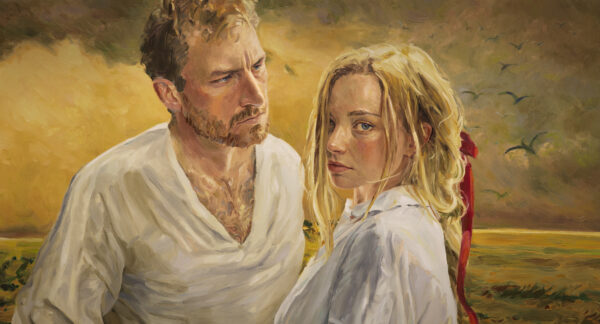
‘The Peasants’ based upon the Nobel Prize-winning novel by Wladyslaw Reymont. The film is directed by Oscar® nominated director Dorota Kobiela and produced in the same painting technique as her previous film ‘Loving Vincent’.
’The Peasants’ is a tragic story of a peasant girl Jagna forced to marry a much older, wealthy farmer Boryna, despite her love for his son Antek. With time, Jagna becomes the object of envy and hate of the villagers and has to fight to preserve her independence. Set in the Polish countryside on the cusp of the 19th and 20th Centuries, the story’s dramatic turns tie into the changing seasons, hard labour in the fields and traditional local holidays.
The epic novel of Wladyslaw Reymont will be brought to life using the popular realist and pre-impressionist paintings from the 19th century, with an emphasis on the Young Poland Movement and the works of such artists as Józef Chełmoński, Ferdynand Ruszczyc and Leon Wyczółkowski.
The special film screening will be followed by Q&A with its producer and co-writer, Hugh Welchman. A graduate of Oxford University, the UK’s National Film and Television School, Hugh has produced 16 short films and two feature films for his company Breakthru Films, winning over 60 prizes at international festivals, including the 2008 Best Short Animation Oscar for ‘Peter and the Wolf’ and European Film Award for ‘Loving Vincent’.
www.facebook.com/thepeasantsmovie
www.instagram.com/thepeasantsmovie
Discussion Panel: New Polish Adaptations
This discussion panel gathers together the creators of some of the most popular recent films and television adaptations and appropriations, available currently on streaming platforms in Poland and abroad.
Our guests are:
- Gabriela Łazarkiewicz-Sieczko, co-writer of Green Border (2023) (real event adaptation / post-literary adaptation)
- Katarzyna Tybinka and dr Anna Gabryś, co-writers of Polowanie na ćmy [Hunting for Moths] (2023) (an adaptation of a historical novel, Pogrom 1905 by Wacław Holewiński, 2018)
- Łukasz M. Maciejewski, co-writer of Król [King] (2020) (an adaptation of a historical novel by Szczepan Twardoch, 2016) and Czerwony pająk [The Red Spider] (2015) (biofiction / appropriation of historical events / post-literary adaptation)